How Much Creatine Should I Take? A Simple Guide for Adults

Summary: Many adults, especially those in midlife and beyond, consume far less creatine from diet alone than what research shows is beneficial. This guide explains how much creatine adults should take, why a consistent 5-gram daily dose is most commonly used in clinical trials, how long results may take, and what older adults and women need to know. Discover what research says about dosing, timing, and long-term support for healthy muscle strength, energy metabolism, and cognitive function†.
How much creatine should you take? It’s one of the most common questions among adults beginning supplementation, especially those who want support for muscle strength, healthy aging, and daily energy†. While creatine is simple to use, online guidance can feel a bit confusing, mostly because much of it is geared toward competitive athletes rather than everyday adults.
The good news is that supplementation doesn’t need to be complicated. Most clinical studies use 3–5 grams of creatine monohydrate per day, and this steady daily amount—not timing or cycling—is what matters most. Cooper Complete Creatine Monohydrate with Creavitalis® provides a full 5-gram serving, aligning with the dosing used in many long-term studies involving adults over 40.
Why Creatine Matters as We Age
Creatine is a naturally occurring compound that the body uses to supply quick energy to cells, especially muscle and brain cells. While the body produces some creatine, we also get it from food, primarily beef, poultry, and seafood. However, even with balanced eating, most adults consume far less creatine than what is commonly used in clinical research.
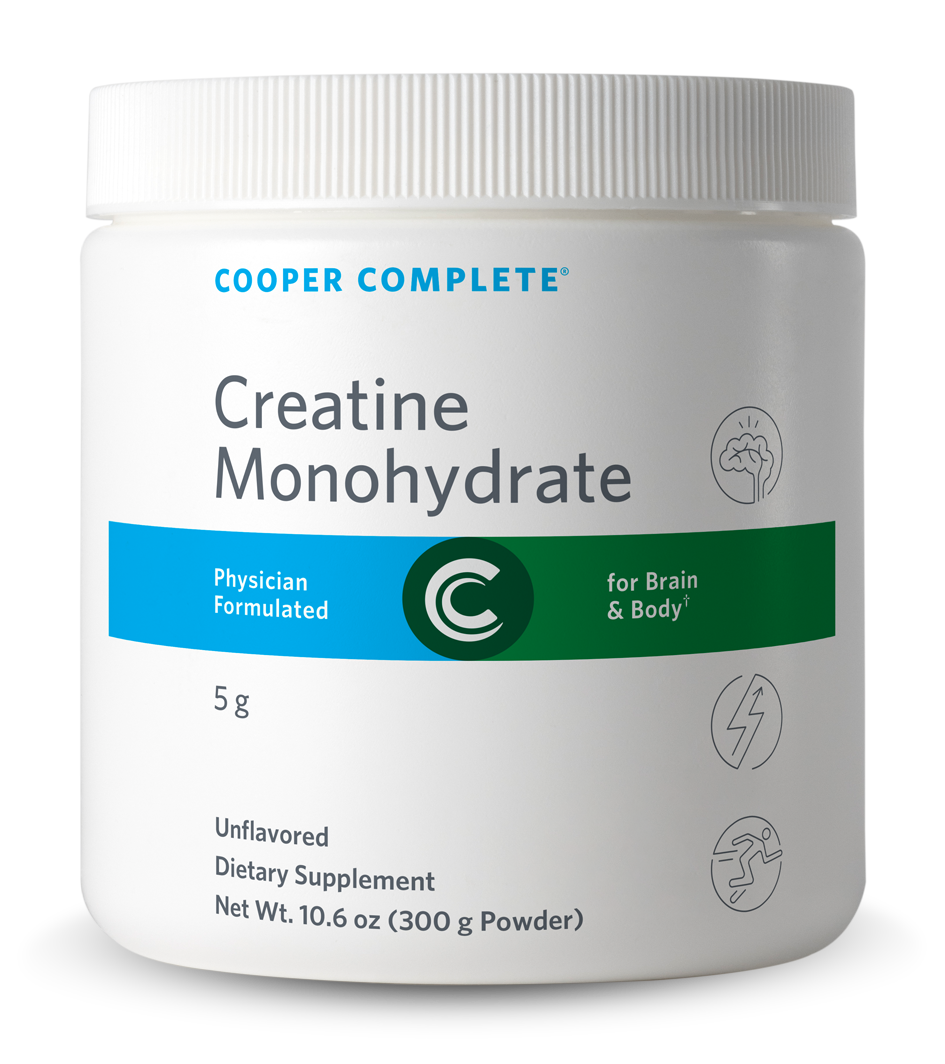
Creatine Monohydrate 5 g
Why Cooper Complete Creatine is Your Edge
Cooper Complete Creatine (Creavitalis®) monohydrate is a high-purity, micronized form of creatine that supports cognitive function, energy metabolism, and muscle recovery.† Our micronized form allows small particles to be better absorbed. Creavitalis® is more than 95% absorbed into the bloodstream. When food alone can’t fully replenish your creatine stores, this helps close that gap.† $34.98 Add to cartPeer-reviewed studies show:
- A 2021 analysis found that average dietary intake among U.S. adults is only ~0.52 grams/day.
- Among U.S. adults age 65+, mean intake is ~0.76 grams/day, with ~70% consuming <1 gram/day.
These low intake levels reflect typical eating patterns. Adults consuming about 1,400 calories/day, common among older adults, often get just 0.5–1 gram/day from food. Adults who eat closer to 2,000 calories/day may consume 1–2 grams/day, depending on their protein choices.
Experts estimate total daily creatine turnover (dietary intake + internal synthesis) at 2–4 grams/day. Because dietary intake often falls short, supplementing can help maintain healthy levels, especially since the body’s natural creatine stores decline with age†.
Creatine Dosage for Adults
Most research supports a daily intake of:
- 3–5 grams of creatine monohydrate per day
This range is widely used in clinical studies involving adults of all ages. Cooper Complete Creatine Monohydrate with Creavitalis® provides the full 5-gram dose used in many long-term trials.
Why 5 Grams May Be Preferable to 3 Grams
- More consistent saturation: Research shows that approximately 5 grams/day helps adults, especially those with low dietary intake, such as vegetarians, vegans, or adults who eat limited amounts of animal or fish protein†.
- Better results in older adults: Research shows that creatine supports both strength and lean mass goals when taken daily†.
- Simpler routine: A single daily 5-gram serving is easy to remember and aligns with the amount most frequently used in published research.
Do You Need a Loading Phase?
Some protocols recommend 20 grams/day for the first week to saturate muscles quickly. While effective, this approach is not necessary for most adults. Without loading, taking 5 grams/day will still raise creatine stores over 3–4 weeks. Loading is most relevant for athletes seeking rapid effects, rather than adults seeking optimal long-term health.
How Long Before You Notice Results?
Creatine benefits build gradually as the body replenishes its natural stores. In longer-duration studies involving adults over 40:
- Meta-analyses show that creatine, paired with resistance training, supports strength and lean mass within 8–12 weeks†.
- One analysis found an average gain of 1.37 kg of lean mass, about 3 pounds†.
- Long-term creatine use has been well tolerated in older adults†.
Some cognitive or energy-related changes may appear sooner, but most physical improvements require several weeks of consistent daily use†.
Recommended Daily Amounts for Older Adults and Women
Older Adults (40+ / 50+)
Because many older adults consume less than 1 gram/day of dietary creatine, supplementation can play a meaningful role in maintaining healthy stores. Studies show that adults 50–80+ who take creatine alongside resistance training experience greater gains in strength and lean mass than those who train alone†.
Women
Women often consume less dietary creatine than men due to smaller portion sizes and lower overall calorie intake. Research uses the same 3–5 gram/day dosing for both men and women, and a 5-gram serving remains appropriate for most women.
Should You Take Creatine on Rest Days?
Yes. Creatine is not a stimulant; it works by maintaining steady levels in the muscle and the brain. Skipping days can cause dips in stores. For best results, take daily, just like a multivitamin.
Does Timing Matter?
In short: timing matters far less than daily consistency.
Some studies compare pre- vs. post-workout timing, but differences are small and inconsistent. Hitting your daily dose is the most important factor.
For a deeper look at timing, visit our article: Should I Take Creatine Before or After Workout?
What to Look for in a Creatine Supplement
Most research uses creatine monohydrate, making it the gold standard. A quality supplement should be:
- Pure creatine monohydrate
- Verified for identity and purity
- Free of unnecessary additives
- Provided at a clinically supported dose (5 grams)
For more information, see our article: Creatine Monohydrate vs HCl: What’s the Difference?
Bottom Line
For most adults, especially those over 40, the most straightforward and most effective approach is:
- Take 5 grams of creatine monohydrate daily.
Consistent daily intake supports muscle strength, lean mass, cognitive function, and energy metabolism†. Whether stirred into morning coffee or blended into an afternoon smoothie, creatine works best when taken regularly. Be sure to talk with your physician or health care provider before starting any new supplement to ensure it is the right supplement for your specific health circumstances and goals.
About the Author: Jill Turner is the President of Cooper Complete® Nutritional Supplements, where she oversees product development and customer experience. She enjoys writing about vitamins, supplements, and preventive health to help consumers make informed, science-backed decisions.
Sources
- Nutrients — Assessing Dietary Creatine Intake in U.S. Population Studies
- Medicine & Science in Sports & Exercise — Creatine Supplementation During Resistance Training in Older Adults—A Meta-analysis
- Nutrients — Creatine Supplementation in Older Adults: A Systematic Review and Meta-Analysis
- Journal of the International Society of Sports Nutrition — Creatine Supplementation Patterns and Benefits: A Systematic Review
- Nutrients — Creatine Supplementation and Skeletal Muscle Energy Metabolism
- Nutrients — Creatine Supplementation and Brain Health Across the Lifespan
- Journal of the International Society of Sports Nutrition — International Society of Sports Nutrition Position Stand: Safety and Efficacy of Creatine Supplementation
- Scientific Reports — Single-Dose Creatine Improves Cognitive Performance During Sleep Deprivation